HCL Schema
Install the VS Code extension →
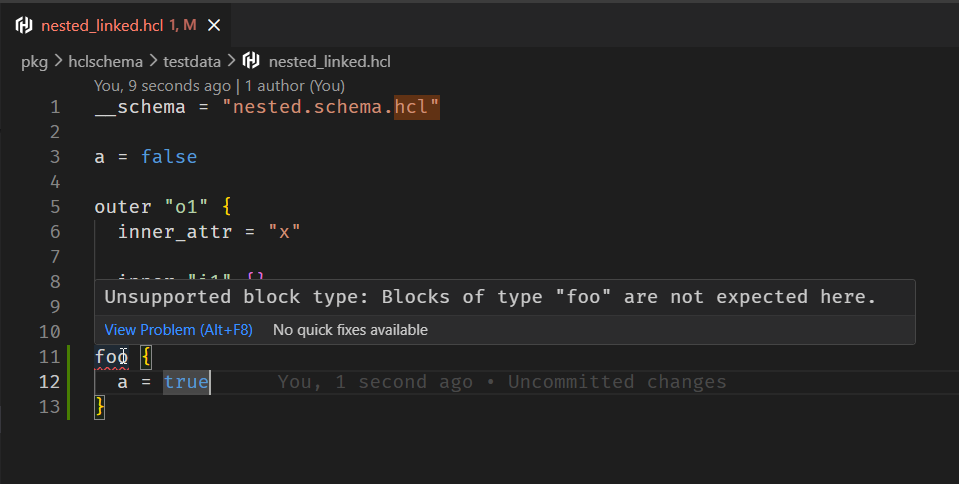
Diagnostics as you type, completion of whatever the schema declares, hover documentation and go-to-definition. The binary ships with it, so there is nothing else to install. See Editors.
HCL has no equivalent of JSON Schema. If your tool reads HCL, the shape of that file lives in your Go code, and the people writing the file find out what it should contain by reading your source or by guessing.
hcl-schema lets you write that shape down, in HCL, as a *.schema.hcl
document — and then check files against it, generate reference documentation
from it, and drive editor completion from it.
__schema = "https://raw.githubusercontent.com/avestura/hcl-schema/refs/heads/main/schema/draft/2026-09/.schema.hcl"
__id     = "https://example.com/service.schema.hcl"

body {
  attribute "name" {
    type        = string
    required    = true
    pattern     = "^[a-z][a-z0-9-]*$"
    description = "The service name, used as a DNS label."
  }

  block_header "listener" {
    label_names   = ["name"]
    min_items     = 1
    unique_labels = true

    body {
      attribute "port" {
        type     = number
        required = true
        min      = 1
        max      = 65535
      }
    }
  }
}
__schema = "./service.schema.hcl"

name = "checkout"

listener "https" {
  port = 443
}
$ hclschema validate .
What you get
| Validation | Structure, types, value constraints, cardinality and cross-field rules, with HCL's own "did you mean" diagnostics. |
| Decoding | The same schema produces an hcldec.Spec, so one document both validates and decodes into typed values. |
| Documentation | hclschema docs turns the description fields into a Markdown reference. |
| Editors | A language server gives diagnostics on the unsaved buffer, completion, hover and go-to-definition. |
| CI | Proper exit codes plus github and sarif output. |
In the editor
Everything a schema declares — types, bounds, enum values, description text
— reaches the person writing the file, as they write it.
The design in one table
The three core declarations mirror HCL's own types one-for-one:
| hcl-schema | HCL |
|---|---|
body | hcl.BodySchema |
attribute | hcl.AttributeSchema |
block_header | hcl.BlockHeaderSchema |
Those three types are small on purpose — they describe only the shallow shape
of a body, because they are the input to Body.Content(). Types, defaults and
cardinality live one layer up in HCL, in
hcldec.Spec, and
hcl-schema mirrors that layer too rather than inventing a vocabulary:
| hcl-schema | HCL |
|---|---|
type | hcldec.AttrSpec.Type |
default | hcldec.DefaultSpec |
min_items, max_items | hcldec.BlockListSpec |
required on a block | hcldec.BlockSpec.Required |
label | hcldec.BlockLabelSpec |
validation | hcldec.ValidateSpec |
open | hcldec.BlockAttrsSpec |
A handful of things have no HCL counterpart and are genuinely hcl-schema's own:
enum, pattern, min, max, deprecated, sensitive, the cross-field
constraints, and the id/ref pair that has been there from the start.
Self-describing
The meta-schema is itself a *.schema.hcl document, and it validates against
itself. There is one language here, not two.